Authentic Basil Pesto (alla Genovese) Made in a Mortar and Pestle
Last updated: May 2026
Allora!
I’m that Guy from Naples.
As a kid, I’ve always preferred to be in the kitchen with mum rather than playing football on the street, hence my passion for my local Neapolitan food heritage. Later on, living in Southeast Asia for many years, I discovered a new culinary world that made me love food even more. No matter where you find me, I'll be doing online and in-person cooking classes, catering, and collaborations with local farmers and food artisans.
I’m excited to be part of the KROK family because they value tradition as much as I do, but at the same time, they don’t see it as a limit for innovation.
When basil season arrives and the aroma from Stefanie’s garden is impossible to ignore, the only logical response is to make it a KROK morning. Once you start to use a KROK it becomes a must-have in the kitchen. I am practically using it for everything I need, from making fresh sauces to pesto or just grinding spices. There are great advantages in using a mortar and pestle instead of knives or a blender.
Let me list some for you here:
Using a blender will produce heat that will interfere with the final taste of your sauce.
The fast and mechanical motion of the blender doesn’t allow the oils contained in your ingredients to come out slowly and blend step by step with the other ingredients.
The blades of the blender are basically cutting the ingredients and will retain part of the precious oils that would have made your outcome much better in terms of taste and texture.
Using a mortar and pestle allows you to calibrate the power and the motion according to the nature of the ingredients.
I could carry on with the list but those above are the basic advantages of using mortar vs. using a blender. You can test it by yourself and believe me, once you have done it you won't come back.
What we generally call “pesto” is Pesto alla Genovese, which comes from Genova, a city of the Liguria Region of Italy. Pesto is actually a technique rather than a dressing here in Italy, so we have many pestos according to the different regions, cities, or areas of Italy.
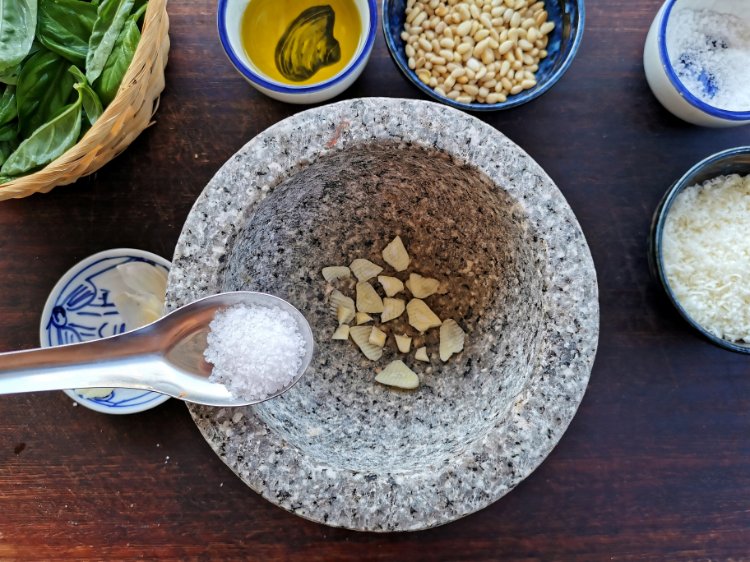
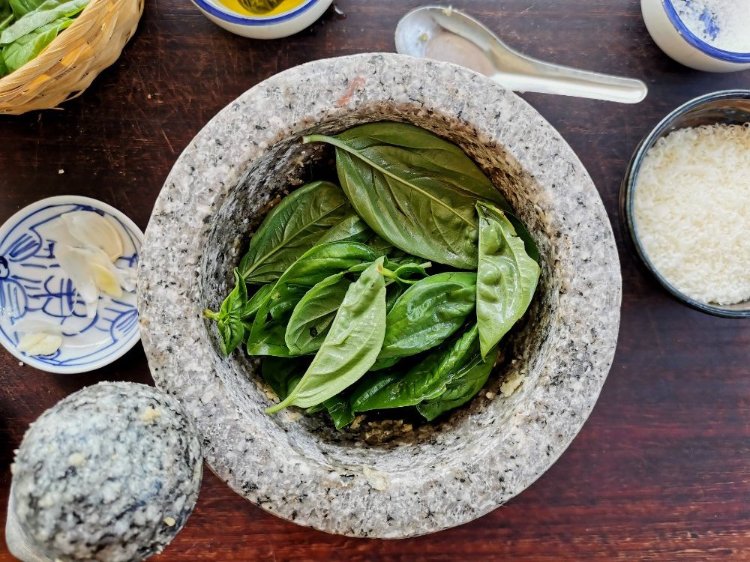
For my Pesto alla Genovese, what I did first was to make sure I had all the necessary ingredients.
Why in the KROK
Pesto is an emulsion, not a puree. The goal is to bruise basil leaves just enough to release their chlorophyll and essential oils without turning them brown or bitter. The KROK's unpolished Thai granite interior grips the leaves instead of letting them move around, while the heavy pestle does the bruising work with minimal effort from your wrist. Because granite stays cool, unlike a food processor that heats up and oxidizes the basil, the pesto stays vibrant green longer. The 3-cup bowl also gives you room to work the pine nuts into an oily paste before the basil ever touches the stone, which is the secret to a creamy, non-gritty texture.
What we generally call “pesto” is Pesto alla Genovese, which comes from Genova, a city of the Liguria Region of Italy. Pesto is actually a technique rather than a dressing here in Italy, so we have many pestos according to the different regions, cities, or areas of Italy.
For my Pesto alla Genovese, what I did first was to make sure I had all the necessary ingredients.
After collecting the ingredients, this is what I did:
Washed my KROK and the basil under running water. Remember that mortars must be washed only with water and before using for the first time, it must be seasoned and conditioned (here is a video on how I conditioned it)
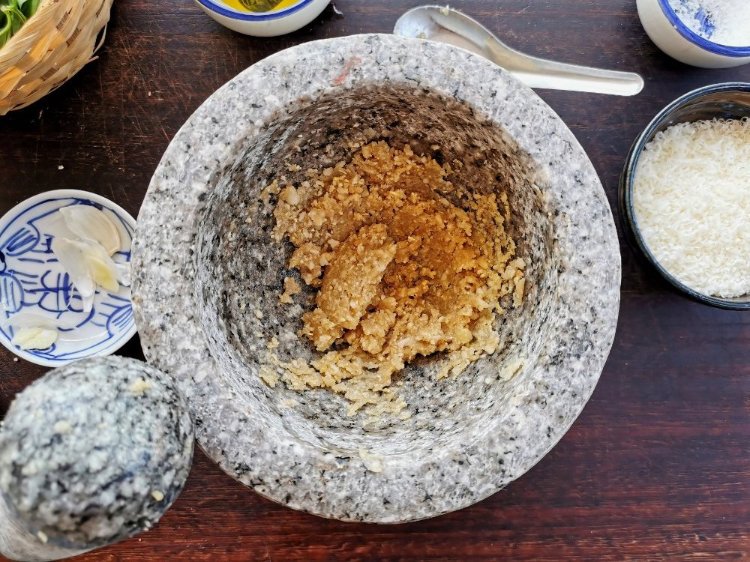
Peeled and sliced the clove of garlic before adding it to my KROK with half a spoon of rock salt. If you are not sure about the salt just add a bit in this stage and if needed you can always add some later on. In addition, rock salt will allow you to increase your “grinding” action; however, you can use fine salt if you don’t have rock.
I added the pine nuts one spoon at a time, same as before: rotating, not pounding with my pestle until I made a paste.
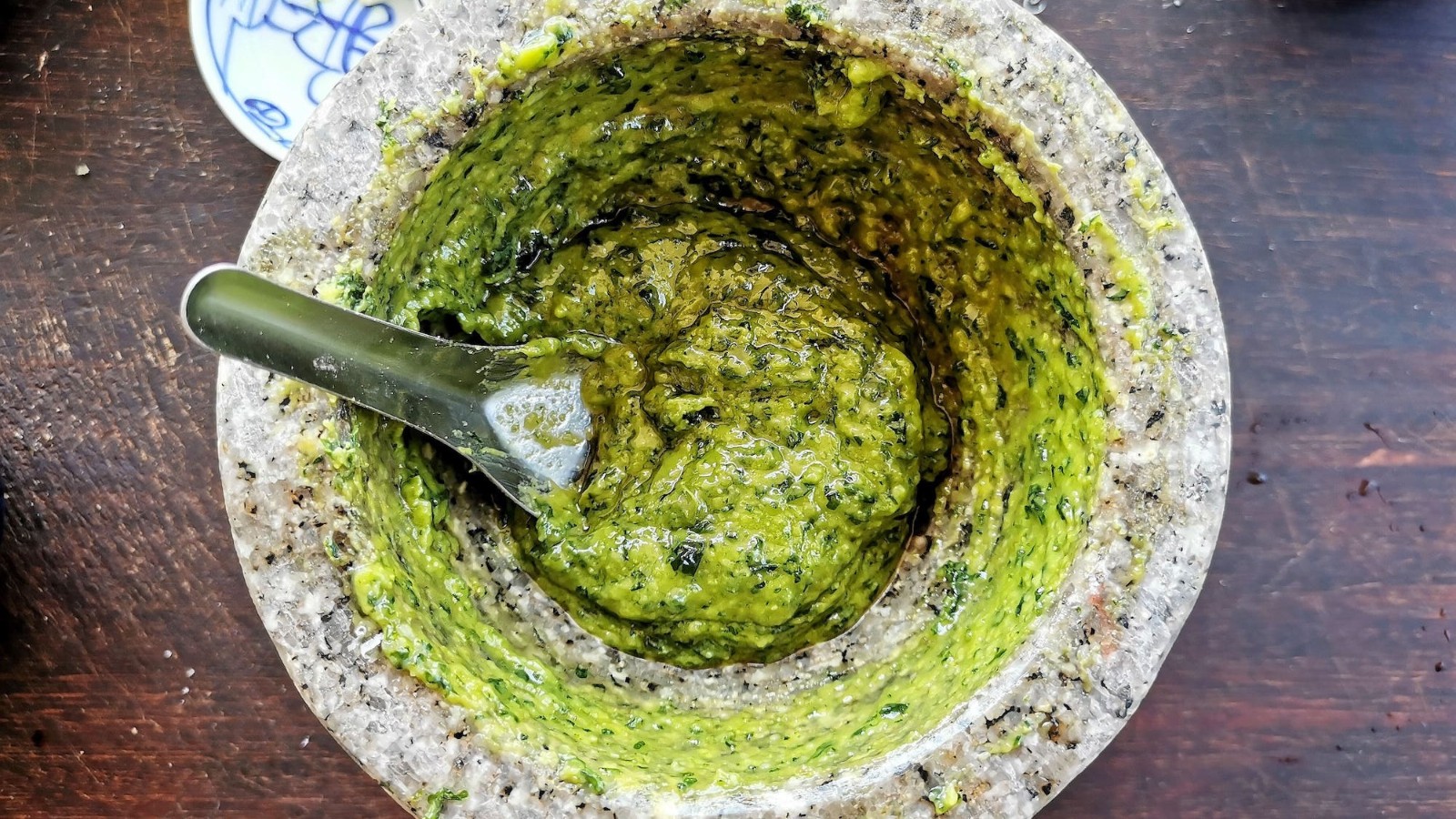
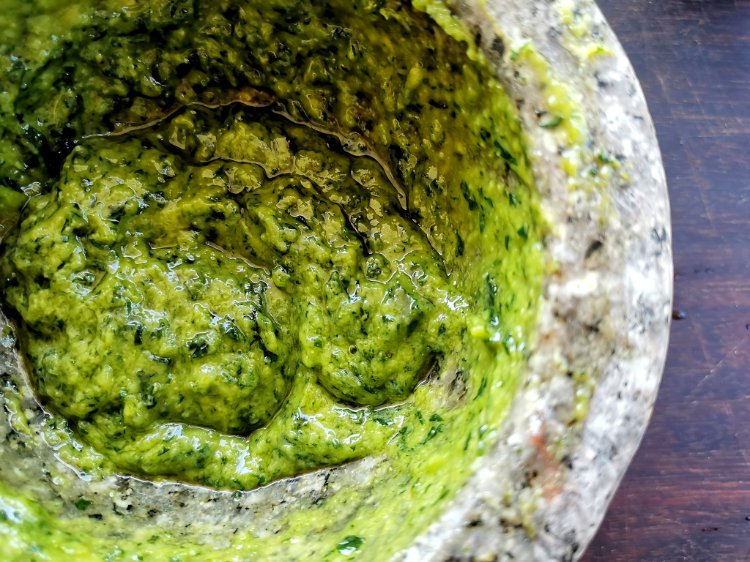
Once the pine nuts were properly “pasted”, I started to add the basil leaves a few at a time. And with the same motion, I started to slowly reach a vibrant green paste continually adding the rest of the basil until all leaves were used.
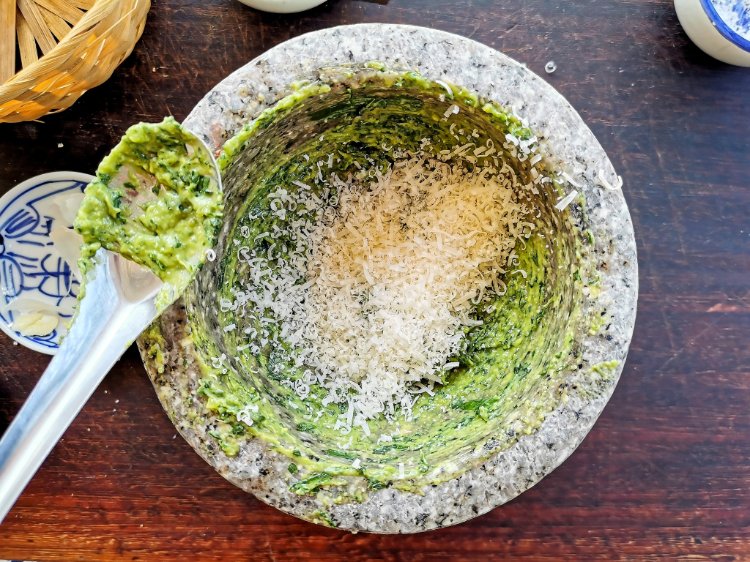
Once you reached a creamy paste, add the cheese and combine all ingredients with the pestle.
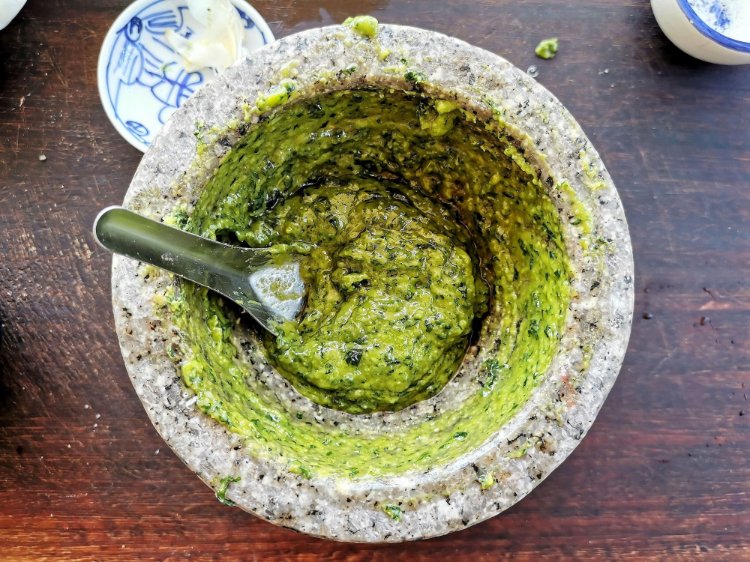
When all the ingredients were properly mixed, I added a spoon at a time of the Extra Virgin olive oil. Adding olive oil not only adds taste to the pesto but also allows you to preserve it for a few days because it has antioxidant properties.
Recipe Note
While you are making your pesto you will be overwhelmed with the aroma coming from the mortar. You will be able to feel the ingredients by their properties. Once you are finished, it will be impossible to avoid slicing some bread and eating it straight from your KROK as I did.
How to preserve your pesto:
Even if I really advise you to eat it freshly made, the Pesto can be preserved in the fridge or even in the freezer. After making the pesto if there is any left over (I doubt it), you can keep it in the fridge for up to 3-4 days. You might want to add some more olive oil over the top to help with preservation. If you’ve enjoyed making pesto so much and you really made too much of it, you can always freeze it. Maybe use an ice mold because one cube makes the perfect amount of dressing for a plate of pasta. Don’t forget to defrost it before using it.
Can you make authentic pesto in a granite mortar instead of Italian marble?
Yes. While traditional Genovese pesto is made in a large Italian marble mortar with a wooden pestle, the KROK's Thai granite performs beautifully for this task. The unpolished interior grips basil leaves instead of letting them skate, and the heavy pestle bruises the leaves just enough to release chlorophyll without the heat that turns pesto brown. You can also purchase KROK's Mango Wood Pestle to recreate the traditional pesto texture. Granite is more durable than marble and will not stain, chip, or react to acidic ingredients. The texture will be slightly more robust than marble pesto, but the flavor is equally vibrant and the tool lasts generations.
Why does my pesto turn brown and how do I keep it green?
Browning comes from oxidation when basil cells are over-chopped and exposed to heat and air. A food processor generates friction heat and whips air into the mixture, both of which accelerate browning. The mortar and pestle method avoids this: the cool granite and manual bruising action release basil oils without heat or over-aeration. To preserve color further, press plastic wrap directly onto the surface to eliminate air contact, and add a thin layer of olive oil on top before refrigerating. Mortar-made pesto stays greener longer than the processor version.
How long does homemade pesto last and can you freeze it?
Freshly made mortar pesto lasts 3–4 days refrigerated with a thin layer of olive oil on top to block oxygen. For longer storage, freeze in ice cube trays. One cube is the perfect amount for a single plate of pasta. Because the mortar method creates a slightly chunkier, oil-rich emulsion, it freezes and thaws more gracefully than processor-made pesto, which tends to separate when thawed. Defrost cubes in the mortar itself for a quick refresh.
First attempt at making pesto and very tasty if I say so myself-thank you for the recipe.
Frank
Thanks for the recipe. Looks like a good one.. Wish you had listed basil in weight or volume. Leaves come in a multitude of sizes. Even on the same plant one large leaf can be the size of three small ones, and if you use baby basil or basil micro greens it can be 10 to 1. Grams or ounces would have been perfect. Thanks
Nin
I love pesto sauce! Either mix with chicken salad or cook with spaghetti! Thank you for the recipe, I will definitely try it!
Annie
Wow so good! This was very easy to follow and very informative. This was by far the best pesto I’ve made!









First attempt at making pesto and very tasty if I say so myself-thank you for the recipe.
Thanks for the recipe. Looks like a good one.. Wish you had listed basil in weight or volume. Leaves come in a multitude of sizes. Even on the same plant one large leaf can be the size of three small ones, and if you use baby basil or basil micro greens it can be 10 to 1. Grams or ounces would have been perfect. Thanks
I love pesto sauce! Either mix with chicken salad or cook with spaghetti! Thank you for the recipe, I will definitely try it!
Wow so good! This was very easy to follow and very informative. This was by far the best pesto I’ve made!
Leave a comment